


Montreal: 32 Years Later, the Testimony of a Survivor of the Rwandan Genocide


A message of solidarity and remembrance was conveyed during the ceremony by the mayor, who was absent for the occasion. In a statement read before the assembly, she recalled the city’s ongoing commitment to “respect for human dignity and human rights,” emphasizing the importance of remembering “the serious violations and principles that have occurred throughout history.”
These moments of reflection, she insisted, are essential to “promote awareness, nurture collective reflection, and strengthen the fight against all forms of hatred and discrimination.”
Beyond the official speeches, emphasis was placed on the profound significance of the commemoration. “To commemorate is to remember, to keep this collective memory alive, but it is also to put words to it, sometimes difficult words,” it was noted, while stressing the ضرورة of creating “spaces to receive and listen with humility.”
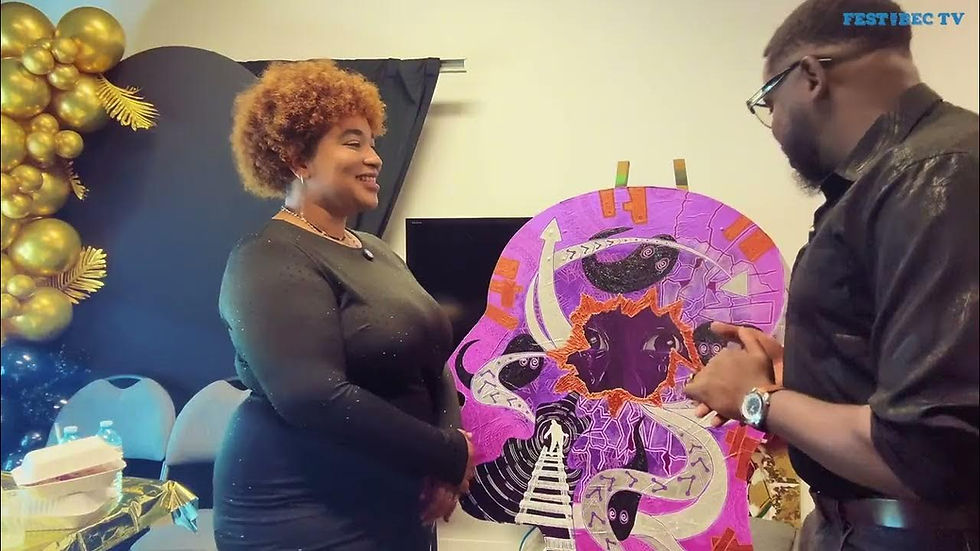
It was in this spirit that the floor was given to Claire Safari, author of Soleil se souvient, who came to share a personal testimony marked by the tragedy of the 1994 genocide against the Tutsi in Rwanda and by a long process of reconstruction.
Visibly moved, she began her remarks simply: “Hello everyone. Excuse me, I’m nervous.” Born in Rwamagana, in eastern Rwanda, she describes a peaceful childhood in a family of five children, supported by teacher parents and a rich cultural environment. “We were still living quite well with educated parents,” she shared, recalling a life shaped by the transmission of values and traditions, particularly through her mother’s artistic activities.
But this stability was abruptly shattered in April 1994. “Like all Rwandans, we were taken by surprise,” she recounts, describing the sudden eruption of violence. Separated from her brother in the turmoil, she found refuge with her sister in centers where daily survival became uncertain. “Every day, we would say… we didn’t know if we would survive the next day,” she remembers.
She speaks of two months spent in extreme conditions, marked by fear, hunger, and the absence of hope. The liberation, which came unexpectedly, remains etched in her memory as an unreal moment: “At 3 a.m.… a miracle.”
After these events, the questions remain, deep and troubling. “Why were they doing this to us?” she wonders, seeking to understand the incomprehensible, especially when neighbors or acquaintances became involved in the violence.
Settling in Canada in 1998, Claire Safari pursued studies in social work and mental health, driven by a quest to understand human nature. “I wanted to study the human being,” she explains, hoping to make sense of what she had experienced.
Years later, an unexpected encounter profoundly altered her journey: meeting a former friend involved in the violence. “I confronted him with a thousand questions,” she recalls. This difficult but essential step allowed her to begin a new inner phase. “That’s when I said to myself: wow… reconciliation is possible. True forgiveness is possible.”
Without denying the pain or erasing the past, she emphasizes a crucial distinction: “Forgiving does not mean forgetting.” For her, speaking plays a fundamental role in the healing process. “What is important is to talk about it… do not remain alone with these wounds,” she urged survivors.
Her testimony concludes with a message that is both personal and universal, marked by nuance and respect for individual paths: “There is no obligation… each person has their own way of moving forward. But we are together.”
Through this account, the commemoration goes beyond the duty of remembrance to become a space for transmission, reflection, and hope, where individual reconstruction meets a collective commitment against forgetting and hatred.


Comments